«ADV-Engineering» LLC
| Address: | 119049, office 106, bld. 3B, 1 Lyusinovsky per., Moscow, Russia. |
| Tel/Fax: |
007 499.237.79.23 |
| Tel: |
007 499.237.67.22 (General Manager) |
| Е-mail: | market@adv-engineering.ru |
| Hours: |
Monday-Friday, 10:00 a.m. to 06:00 p.m. GMT+4.00 Moscow |
Complete version of this page: Thermoelectric materials on the basis of bismuth telluride Bi2Te3
Thermoelectric materials on the basis of bismuth telluride Bi2Te3
The bismuth telluride Bi2Te3 compound is a semiconductor material, possessing likewise р- and n – conductivity.
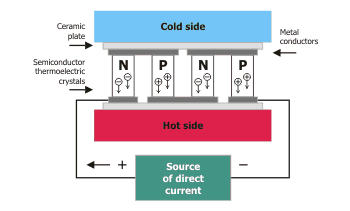 Moreover, bismuth telluride crystals bear a remarkable quality. If, being prepared in a certain way semiconductor Bi2Te3 crystals (they are also called «pellets») of the n- and р-types of conductivity are alternatively joined sequentially with each other by metal conductors, and this «package» is placed between two thermally conductive ceramic plates, then you get a device which is called the thermoelectric cooling module (TCM). When transmitting the direct electric current through the thermoelectric module the upper junctions of the «pellets» will become cool, while the lower – get warmer. As a result one ceramic plate is cooling the environment, while the opposite plate is the source of heating. But if the direct current is transmitted through the same device in the opposite direction, then the «hot» and «cold» sides shall change places.
Thermoelectric modules are used for the production of electricity through the direct transformation of heat into electricity. Electricity is produced, when heating the thermoelectric module connected to the electric circuit. The thermoelectric generating modules (TGMs) possess this property.
The unification of one or several TE modules and two heat exchangers of an aerial or liquid type, which are attached to the hot and cold sides of the modules into basic thermoelectric blocks (BTBs), allows to build a thermoelectric system of a given capacity.
Quality control of thermoelectric materials
The Hartman’s method of measuring thermoelectric parameters is used in order to control the quality of thermoelectric materials. When using this method to obtain precise calculations of the characteristics of thermoelectric efficiency it is necessary to apply corrections that are related to the thermal conduction of the lead and sound wires, with the thermal emission from the sample and wires, and also with the Joules heat, emitted in the lead wires.
So far, when calculating the thermoelectric efficiency the registration of the corrections was not based on the solution of the task of thermal conduction in the system: «The sample – lead wires». The specialists of the «ADV-Engineering» LLC . solved this problem in a one-dimensional approximation and on this basis worked out a method of a more correct way of measuring the thermoelectric efficiency of the sample.

1- sample, 2 – current distributing copper plate, 3 –constantan wire, 4 – current copper wire, 5 – sounding copper wire.
Such a scheme allows to measure not only the thermoelectric efficiency, but also the thermo e.m.f., the electric conductivity and thermal conduction.
Thermoelectric generating material on the basis of bismuth telluride Bi2Te3
Method of production – extrusion
The material is produced in the form of pencils with a cross-section of 5х5 mm2, out of which “crystals” are cutfor generating modules
Thermoelectric properties of n-type crystals:
- Zeebeck’s coefficient at 300K
σ ≥ (140÷180)·10 -6V/K
- Specific conductivity at 300К
σ = (1300÷1700) Ocm -1·cm -1
Thermoelectric properties of p-type crystals:
- Zeebeck’s coefficient at 300K
σ ≥ (130÷170)·10 -6 V/K
- Specific conductivity at 300К
σ = (1400÷1800) Ohm -1·cm -1
Ingots and crystals (pellets) of bismuth telluride
«ADV-Engineering» Co., Ltd. produces ingots and pellets of p- and n- type conductivity from alloys on the basis of bismuth telluride to us them likewise in cooling an conditioning systems, and for generating electric power:
1. ingots of alloys, obtained by using the method of zonal recrystallization;
2. ingots of alloys, obtained by using the extrusion method;
3. pellets for thermoelectric cooling and generating modules.
Thermoelectric elements (pellets) represent parallelepipeds or cylinders with a metallic covering on opposite sides.
Technical characteristics of the product
Ingots of bismuth telluride of the n- and p- types of conductivity
- Zeebeck’s coefficient at 300 К – a > 195·10-6 V/K
- Electric conductivity at 300 К – o = 900 ÷ 1180 Ohm-1·cm-1;
- Thermoelectric figure of merit at 300 К – Z > 2.8·10-3 1/K и Z > 3.0·10-3 1/K;
- Diameter of the ingot – 7 mm и 20 ÷ 22 mm;
- Length of the ingot – 60 mm.
Crystals (pellets) of p- and n – types of conductivity for thermoelectric generating modules
| Parameter |
n-type |
p-type |
| Zeebeck’s coefficient at 300 К, V/К |
(150-160)x10-6 |
(140-150)x10-6 |
| Electric conductivity, Оhm -1x cm-1 |
1200-1400 |
1600-1800 |
| Geometric dimensions*, mm |
5x5 |
5x5 |
*Geometric dimensions of crystals (pellets) can be changed in agreement with the client.
Crystals (pellets) from bismuth telluride Bi2Te3) of p- and n-types of conductivity with metallic covering for thermoelectric cooling modules
Conditions of delivery and payment
Terms of delivery, payment and prices of the products are determined by the conditions are determined by the conditions of the Agreement with the Client.